Approval Workflows That Hold Up in an Audit
November 17, 2026
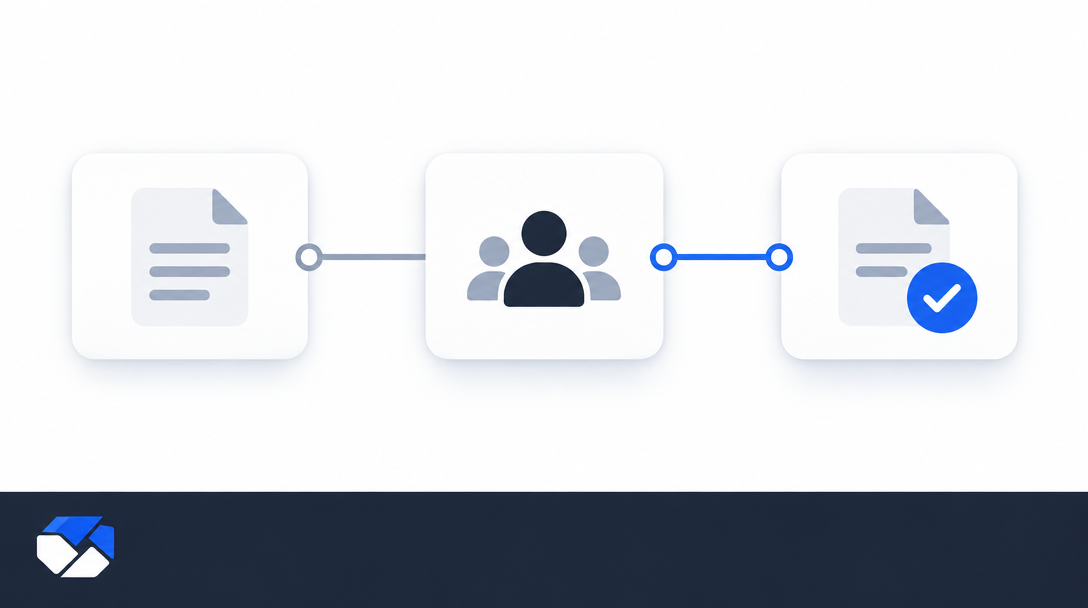
An approval workflow is not a formality. It is the evidence that the people with the right authority reviewed a document before anyone worked from it. When an auditor asks for that evidence, a chat message saying "approved" is worth very little.
Here is what a document approval workflow needs to capture, how to route it, and why so many approved-looking processes fail under review.
What an approval workflow has to record
An auditor is not evaluating whether your team has good judgment. They are checking whether the approval can be proven, for the right version, at the right time, by the right person.
A workflow that holds up records six things for every approval:
- The exact revision approved. Not the document in general, but the specific version number, with the content of that revision preserved.
- The identity of each reviewer and approver. Named individuals, not a role placeholder or an unnamed department inbox.
- The action taken. Review, approval, rejection, or request for change, recorded per person.
- The timestamp. When each action happened, relative to when the document was released and used.
- The sequence. Who acted before whom, because an approval that precedes its review is not an approval.
- The context. Comments, requested changes, and the reason for the revision, so a later reader understands why the document reads the way it does.
If any of those is missing, you may still have a well-run process. What you do not have is a defensible record of one.
Reviewer versus approver
Teams frequently collapse these two roles, and it causes trouble in two directions.
A reviewer examines the document for accuracy and practicality. They may be a subject matter expert, a line supervisor, or someone from an adjacent function such as regulatory or production. Their job is to find problems.
An approver authorizes release. They carry the accountability for the document being suitable for use, and in many systems the approval is tied to a specific role in the quality structure, such as the quality manager or document owner.
Keeping them separate does two useful things. It stops a single person from both writing and blessing their own work, which is exactly what auditors probe when a document has one signature on it. It also makes the review genuinely useful, because reviewers know they are not the final gate.
Where the separation is not practical, such as a small team, make the combined role explicit in your procedure and record that decision rather than leaving it ambiguous.
Sequential versus parallel routing
There are two common patterns for moving a document through people, and both are legitimate.
Sequential routing sends the document from one person to the next in a defined order. It suits documents where later approval depends on earlier review, or where one reviewer's comments could change what the next reviewer sees. It is slower and easier to evidence.
Parallel routing sends the document to several reviewers at once and collects their responses before moving to approval. It is faster and works well for cross-functional documents such as a procedure that touches production, quality, and maintenance.
Most organizations use a mix: parallel review across functions, then a single or joint approval step.
The design mistake to avoid is parallel approval where competing comments need resolution. If two approvers respond simultaneously with conflicting edits, someone has to reconcile them, and that reconciliation needs to be visible in the record. Route the document back through a controlled revision step rather than letting parallel tracks quietly diverge.
Periodic review and re-approval
Approval is not a one-time event for the life of a document. Documents drift out of date as processes, equipment, suppliers, and regulations change.
Build two triggers into every controlled document:
A scheduled review date. Set it by risk, not by habit. A safety-critical work instruction may need annual review. A general policy may be fine on a two or three year cycle. What matters is that the date is stored in the system and produces a task, not that the interval is short.
Event-driven review. Revisions triggered by a change in process, a deviation, an audit finding, a supplier change, a regulatory update, or a customer requirement.
When the review happens and nothing changes, record that outcome. A documented "reviewed, no change required" with a date and a name is a valid result. Silence is not, because an auditor cannot distinguish a review that found nothing from a review that never happened.
Change control and signature expectations
Every revision should carry a reason. A change summary in the document header tells the reader what changed. The approval workflow should also capture why, in a sentence or two, so the rationale survives staff turnover.
On signatures, the standard you work under decides the detail. ISO 9001:2015 requires documented information to be reviewed and approved for suitability and adequacy, without prescribing a signature technology. ISO 13485:2016 and 21 CFR Part 11 are stricter about electronic records and signatures, including requirements for audit trails that independently record the date and time of actions that create, modify, or delete records.
Even where e-signature rules do not formally apply, the practical test is the same: can you show who approved this revision, in what capacity, and when? If the answer depends on searching someone's mailbox, the workflow is not evidenced, only remembered.
Where approval workflows stall
Most stalled workflows fail for organizational reasons rather than technical ones.
Approval authority is unclear. If nobody knows who is allowed to approve a given document type, documents wait while people ask around. Publish an approval matrix once and keep it current.
One approver becomes a bottleneck. A single person approving everything creates a queue and encourages workarounds. Delegate by document type and record deputies.
The workflow does not match how people work. If a procedure requires three signatures but the culture treats one as sufficient, you get informal approvals and formal silence. Adjust the matrix to something the team will actually follow, then hold the line.
Reviewers sit on documents. Add due dates and escalation to another named approver, and keep the escalation visible.
Nothing prompts the next review. Without a scheduled task, review happens only when someone remembers, which usually means after an audit.
Choosing a workflow you can prove
When you evaluate document control software, test the workflow against one question: can it show me, for this specific revision, who reviewed it, who approved it, in what order, and when, without anyone reconstructing the story afterward?
BaselineDocs is built for that question. Approval workflows route documents to the right reviewers and approvers in a defined sequence, and the approval, the version, and the audit trail stay attached to the same document, so the record of the decision is as durable as the document itself.
FAQ
How many approvers does a document need? Enough to cover the accountability your procedure defines, and no more. Most organizations use one or two approvers per document type, defined in an approval matrix rather than decided per document.
Can one person review and approve? In small teams it happens. Make it explicit in the procedure and record the reason, rather than leaving the appearance of separation that is not there.
What if a document must be used urgently before approval completes? Document the deviation explicitly, with the risk accepted, the person accepting it, and a deadline for completing approval. Undocumented urgency is the finding.
Do we need to re-approve after a minor typo fix? If the change affects meaning, instructions, or compliance, it is a revision and needs approval. If it is purely cosmetic and your procedure allows administrative correction, say so in the procedure and record the correction.
Approvals your team can prove
If your approvals live in email threads and memory, every audit turns into archaeology. Put review and approval in one controlled workflow instead.
Start Free Trial and see how a documented approval looks when it is captured automatically, against the right version, at the right time.